
Falkirk Council agrees Banknock quarry restoration must protect newts
Planning permission to restore the landscape around a former quarry in the Falkirk Council area will destroy the habitat of a “nationally important” population of an endangered species, councillors heard this week.
But members of Falkirk’s planning committee were also told that there are plans to relocate the great crested newts from the old quarry site at Cowdenhill, so work can start to partially fill the quarry void and upgrade the site access road, which leads to the A803.
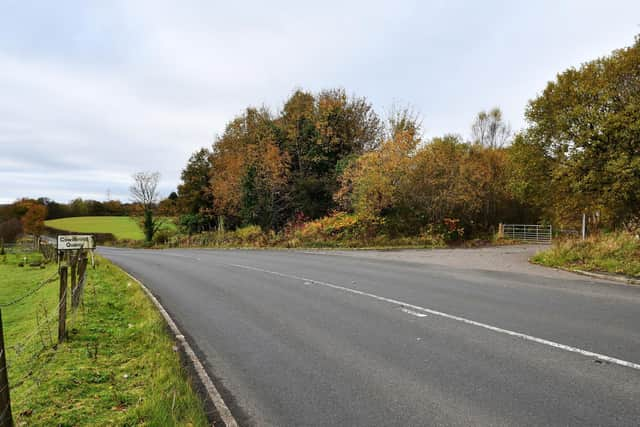

Councillors were told that the work at the site near Banknock will be supervised by watchdog NatureScot and will require a licence, without which there will be no permission.
The Falkirk application comes after North Lanarkshire Council (NLC) granted Holcim UK Ltd permission for a new quarry to open at Tomfyne, which will involve extracting 350,000 tonnes of hard rock per year over 21 years.
Councillors were told that the Falkirk application must be considered separately from the Tomfyne plans, which were approved in April by NLC.
But Banknock resident Jennifer Pitcairn told the meeting that the two applications are “directly linked” as no quarrying can proceed without upgrading the road in the Falkirk Council area.
“This isn’t just a road upgrade and restoration – the overburden from Tomfyne will fill the void, the void will take surface water from Tomfyne, and the road will carry Holcim’s aggregates,” she said.
The Banknock quarry was never restored, as it should have been, after its sudden closure 15 years ago.
At the time, there had been numerous complaints by residents about the HGV traffic, dust, noise and spillages caused by the operation, under a different company.
Ms Pitcairn said many neighbours are concerned that these issues will arise again, as most of the HGVs will pass through the Falkirk area village when entering and leaving the North Lanarkshire site.
And she questioned the need for restoration, given that the area has naturally become a haven for wildlife in the 15 years since it was abandoned.
As well as the great crested newts, other protected species, such as peregrine falcons and barn owls, are now found there.
Both North Lanarkshire and Falkirk councils have requested several conditions in a bid to ensure that similar issues can be avoided.
Speaking on behalf of the applicants, Holcim UK Ltd, Stephen McLachlan said that restoring the former quarry would make the area safer and would reduce flood risk.
The applicants also confirmed that sheeting will be used along with wheel washes to reduce dust and spillage.
Mr McLachlan added that the environmental watchdog SEPA has reviewed the proposals and had not objected.
Addressing the issue of relocating the great crested newts, he stressed that this cannot be done without the approval of NatureScot and said the firm is working closely with the government agency to ensure that the relocation is done carefully.
The new ponds for the newts will be created first and any licence will be granted once all the details of the move have been finalised.
Holcim will also have to demonstrate that they will eradicate the invasive Japanese knotweed that has been found across the site.
Ms Pitcairn was critical of North Lanarkshire’s decision to go ahead with quarrying and urged members not to support the application as Falkirk Council’s policy is to have no new quarrying operations.
The Scottish Government also favours using recycled aggregate, rather than opening new sites.
She told members: “Even if I take my heart out of this decision and just look at it with my head, I still can’t see how this application doesn’t go against policy,” she said.
Speaking on behalf of Holcim, Kim McLaren acknowledged that residents had repeatedly raised their concerns about dust during consultations and she assured members that measures will be taken to prevent this.
There will also be a community liaison group and a monitoring officer to report back to North Lanarkshire and Falkirk councils when complaints are raised.
Councillors Fiona Collie and Laura Murtagh attempted to add a condition that would make clear the protection needed for the great crested newts but other members said they were satisfied with the licensing process and conditions that are already in place.
The application was approved, subject to conditions, including the licence from NatureScot.